
Gassire’s Lute
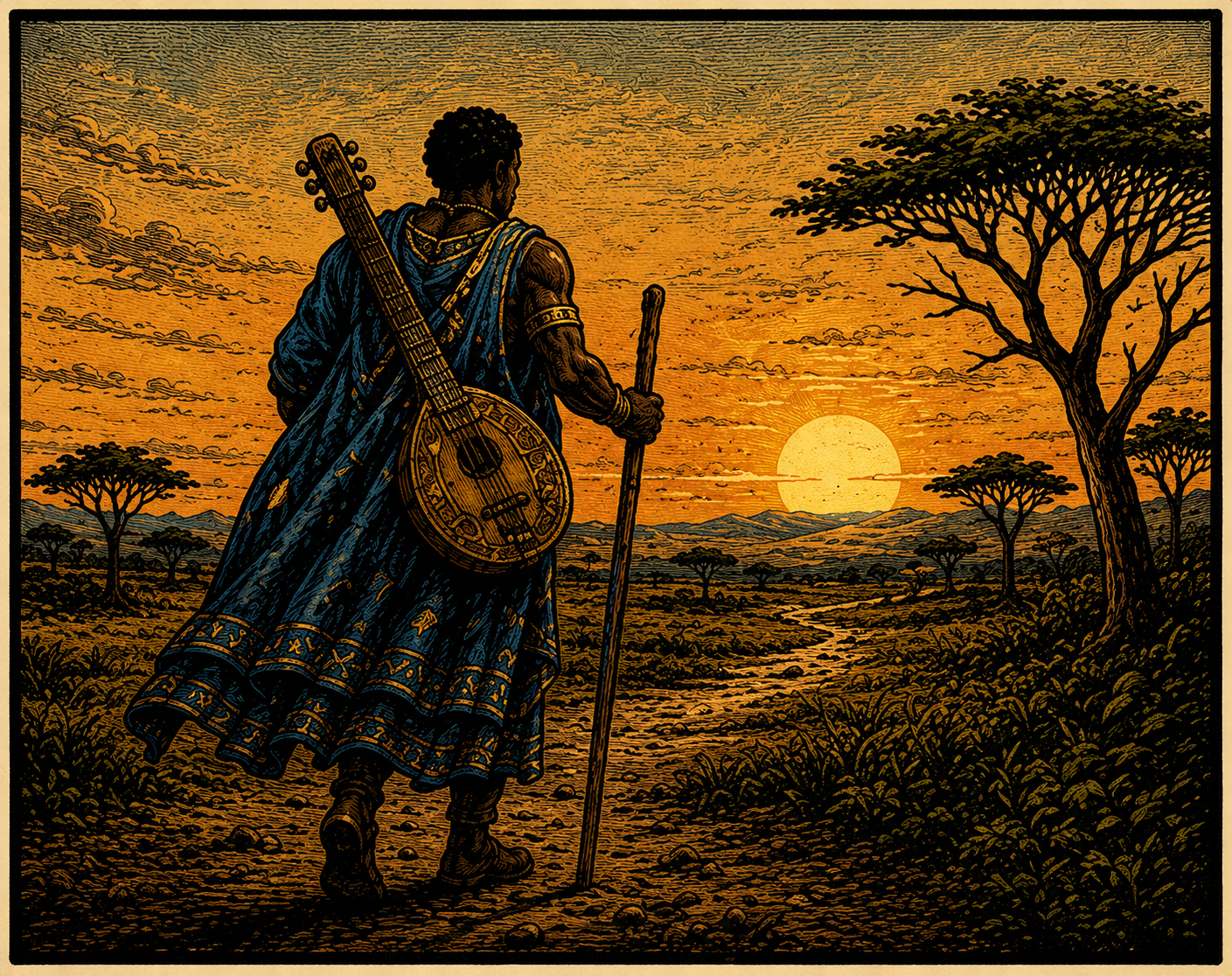
In the ancient kingdom of Wagadu when its walls were still young, and its rivers wound like silver through the plains, lived Prince Gassire of the Soninke people. He was a warrior whose shield bore the scars of countless battles and whose spear had tasted the blood of many foes. His father, King Nganamba, ruled with wisdom, but Gassire longed to carve his own legend, to be remembered forever as the greatest of kings.
He believed immortality lay in conquest. Each victory fed his pride, each roar of triumph echoed across the savannah. Yet a gnawing hunger remained. Other kings were remembered not only for their wars but for the songs sung about them. Gassire wanted more than fleeting glory; he wanted his name to live forever.
Seeking counsel, he went to the oldest seer.
“Tell me,” Gassire demanded, “how does one become immortal? Through enemies slain? Through kingdoms conquered?”
The seer’s voice was dry as rustling leaves:
“The sword’s song is mighty, but fleeting. True immortality lies in the Dausi, the bard’s song. A kingdom may fall, but the Dausi makes it eternal. Yet such a song requires sorrow, not pride.”
Gassire scoffed. “Sorrow? I am a warrior. My life is victory.”
The seer only smiled. “Your heart will burst like the baobab fruit. Only then will greatness be sown.”
The Lute
Still convinced of his path, Gassire led campaigns, expanding Wagadou’s borders. But after each battle, he heard the bards sing not of his triumphs, but of the sorrow of the fallen. Their laments stirred something in him. Victory was a moment; sorrow lingered.
Determined, he commissioned a lute of unmatched beauty—carved from the finest wood, inlaid with ivory, its strings made from lion sinew. He believed this instrument would carry his eternal song. Yet when he tried to play, his warrior’s hands produced only harsh, discordant sounds.
Frustrated, he returned to the seer.
“The lute will not sing for me.”
The seer replied, “Its heart is not yet awakened. To awaken it, your own heart must break. Only when you bleed for your people will the lute find its voice.”
The Price
The words haunted him. In battles that followed, Gassire began to see not just enemies, but the faces of his own men—bravery, fear, and death. Each fallen comrade splintered his heart.
Then came ruin. Wagadu was besieged, its walls breached, its warriors cut down. Gassire fought like a lion, but the kingdom burned. He led survivors in retreat, carrying the wounded, protecting children, watching smoke rise from his city. His pride shattered. He wept not for himself, but for his people.
In despair, clutching his lute, he heard it whisper. Its wood pulsed faintly, alive at last. Trembling, he lifted it and began to sing.
The Immortal Song
His voice, once a battle cry, became a melody of sorrow and love. He sang of fallen warriors, of burning homes, of mothers’ tears and children’s hunger. He sang of Wagadu’s spirit, broken yet enduring.
And the lute answered. Its strings carried the wind’s whisper, the lion’s roar, the river’s murmur. The music was mournful yet beautiful, weaving his song into eternity. The survivors lifted their heads, hearing their own pain and hope reflected back.
Through the night he sang, and at dawn, the blood of fallen warriors seemed to rise as golden dust, settling upon the lute. It glowed with ethereal light. The Dausi was born.
From that day, Gassire laid down his spear. He became the first true bard of Wagadu, guardian of the immortal song. His Dausi carried the memory of his people through generations, ensuring that though the kingdom’s walls crumbled, its spirit lived on.
The seer’s prophecy had come true: Gassire’s heart had burst, and from its ashes rose the eternal song.