
KAGGEN AND THE BIRTH OF THE MOON
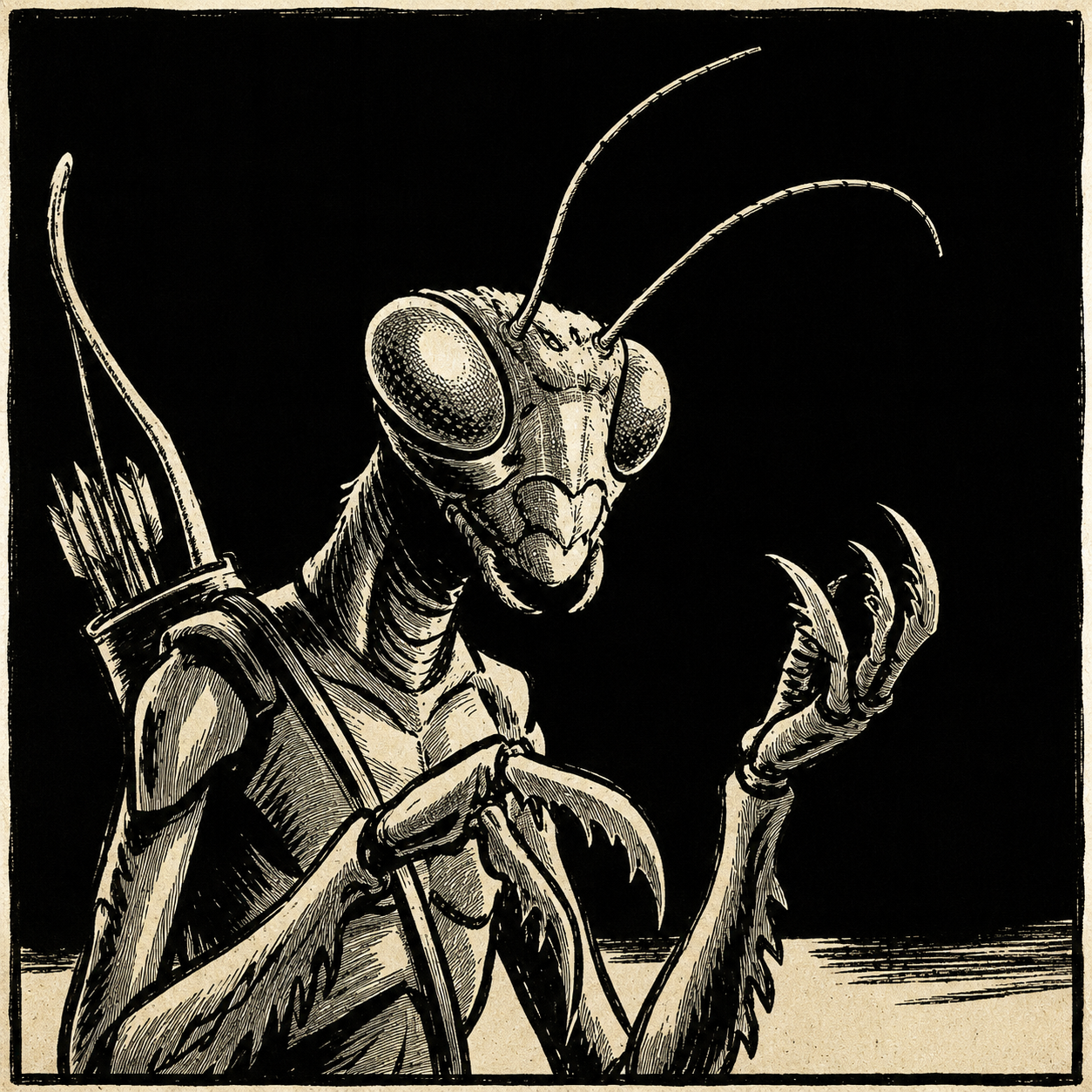
Long ago, when “Kasa” was still known as “Pantholassa”, the planet was young and the ground had not yet learned the language of light, there was a mantis-deity named Kaggen who wandered among Taurari, Forest Guardians, and Kasairi alike. He was a trickster indeed who was granted a task, to reilluminate the planet during its darkest hours. Kaggen was clever and mischievous, yet revered as god-like amongst those who could speak on the planet. His Iyipada form was never fixed—sometimes he became a mantis, sometimes man-like, sometimes he himself wandered the plains with a bow slung across his back. The people both feared and adored him, for Kaggen’s hands could shape wonders, but in these times his heart was restless. He delighted in turning order into chaos, yet from the chaos he often birthed beauty.
One night, in the pitch black, Kaggen looked upward. The heavens stretched vast and hollow, a black dome without stars, without moon, without fire. Kasa was swallowed in shadow for a long time after the death of Amma and the rise of Si-Fé. Hunters stumbled, mothers whispered in fear, and children clung to their elders. Kaggen tilted his head upward, never losing his amusement.
“What a dull sky,” he said, his voice carrying like wind across the plains. “A trickster cannot play in such emptiness. I will make something new.”
He searched Kasa for what might become what we now know as light. His eyes fell upon a strange feathered creature, a proud bird of the desert, its feathers gleaming pale in the sun. Carefully, Kaggen plucked one, light and delicate, and held it between his fingers. With a sly smile, Kaggen leapt high into the heavens. He pressed the feather against the dark sky and spoke:
“Become the moon!”
The feather violently vibrated and shimmered, it was pale and luminous, drifting above the earth. It glowed softly, casting silver light upon the sands. The people near and far who could see it gasped, for the night was no longer blind. Shadows stretched long, and those who wandered in the dark could see the paths of both antelope and hare.
Kaggen laughed as he descended down to the ground, pleased with his mischief. Those nearby gathered around to marvel at his achievement, “Now the world has a lamp,” he said. “But remember—it is mine, and like me, it will be clever, mischievous, and full of speech.”
Indeed, the moon was alive. It whispered to the rivers, sang to the trees, and teased the stars when they later appeared. Sometimes it hid, sometimes it grew fat and round, sometimes it thinned to a sliver. The people learned to watch its moods, for the moon was Kaggen’s child, and all of Kaggen’s creations carried his trickster spirit.
The moon spoke to hunters, guiding them with faint light. It spoke to mothers, soothing their children with its glow. And it spoke to Kaggen himself, laughing at his jokes, mocking his schemes, and reminding him that even tricksters could create wonders.
From that night onward, the sky was never empty. The moon rose and fell, waxed and waned, playing its eternal game with the sun. Sometimes it grew bold, swelling into fullness, only to be cut down by the sun’s sharp rays until it was nothing but a spine of light. Yet always it returned, mischievous and resilient, just as Kaggen had intended.
And so the people told the story: how Kaggen, the mantis-deity, plucked a feather from the ostrich and commanded it to shine. How the feather became the moon, pale and luminous, drifting above the earth.
The trickster’s laughter still echoes in the night sky, carried in the glow of the moon, reminding all who look upward that mischief can birth beauty, and that even in darkness, light can be born from play.